Is Agent Development a Necessary Pursuit for the Average Programmer?
I am presently engaged in the development and iteration of two projects. Interested parties may contact me directly to join the project group.
- [HuaShui AI] A Node full-stack AIGC knowledge base encompassing AI writing and real-time collaborative editing. Complex business logic, deployed in production.
- [ZhiYu] An AI Agent project functioning as an intelligent interviewer — capable of resume optimization, simulated interviews, and question resolution.
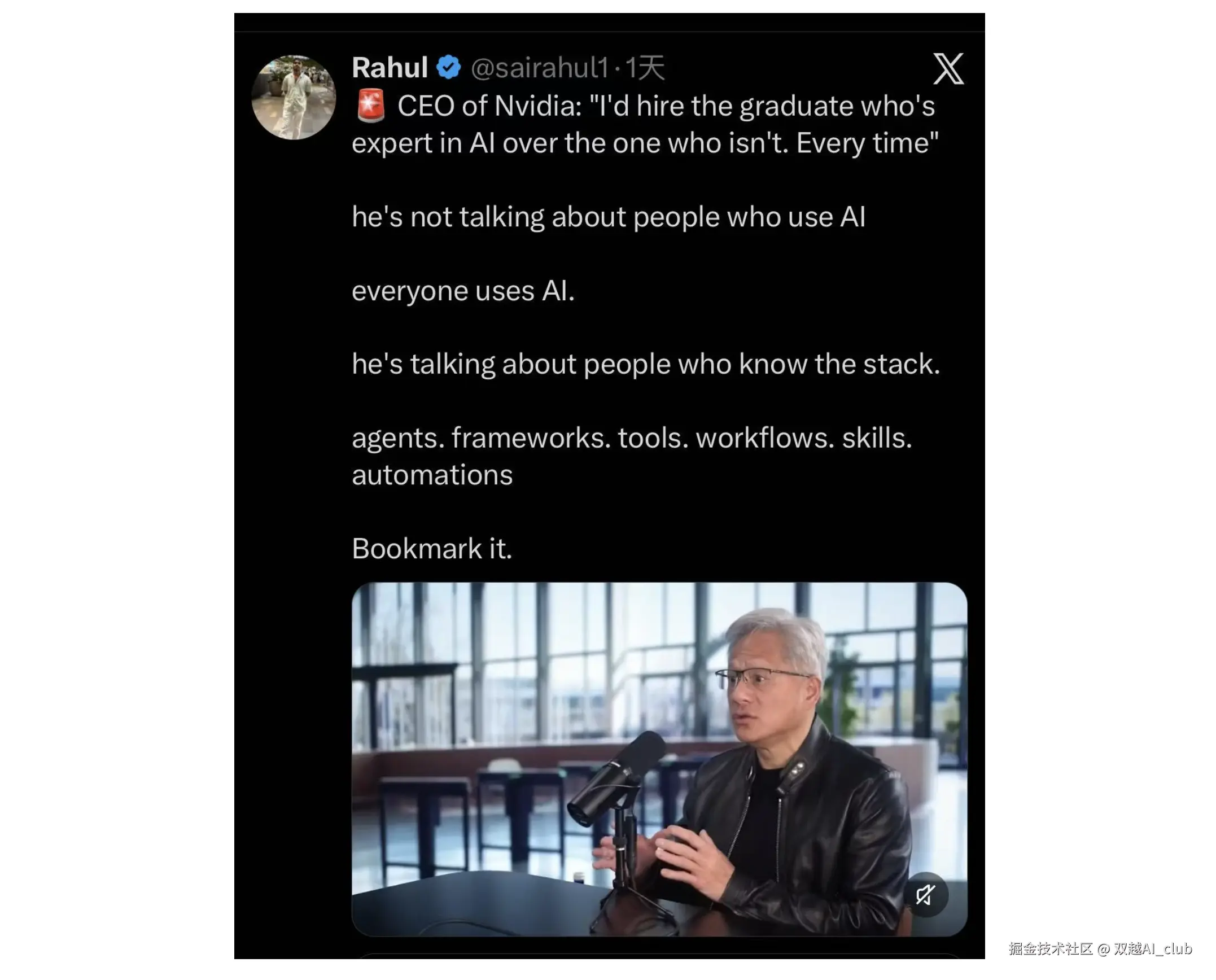
Foreword
Agent-based architectures began gaining traction in 2025, catalyzed by the MCP protocol's proliferation, which enabled agents to interface with third-party services.
Subsequently, the widespread adoption of Skills demonstrated that AI combined with skills could evolve into domain-specific expertise, permeating diverse vertical industries.
By spring 2026, OpenClaw had taken the internet by storm, shortly before Hermes emerged as its would-be successor.
The Claude Code source code leak further exposed its internal architecture, while Codex is currently being actively promoted and adopted.
2026 stands as the peak year for agents — globally, organizations are both building with agents and building agents themselves.
The question naturally follows: as rank-and-file programmers, we all leverage agents — at minimum for AI-assisted coding. But is deep study of AI Agents truly necessary?
The answer is an unequivocal yes.
Toward Superior Agent Utilization
Across every domain, mastery of any tool or technology demands an understanding of its underlying principles and architecture.
Consider a developer who persistently uses a single Cursor chat session, intuitively believing that accumulated context yields superior AI responses. In practice, however, this approach increases the risk of context pollution and amplifies the likelihood of AI hallucination.
This touches upon a core Agent module: context management and compression.
Furthermore, Claude Code and Cursor offer a range of advanced capabilities — subagent hooks, among others — which developers unfamiliar with the architecture may instinctively avoid, limiting themselves to basic skill configuration.
A thorough study of harness engineering renders these concepts and modules immediately familiar — their purpose becomes self-evident without guesswork.
Concerns over the security of AI-generated code are allayed by a proper understanding of agent architecture: agents are governed by rigorous permission and security mechanisms. Furthermore, prompts can be configured to mandate unit test generation that conforms to predefined quality thresholds.
This parallels the frontend interview practice of examining source code proficiency. Vue and React are accessible to all, yet those versed in their internals wield them more effectively. Candidates may decry the hyper-competition, but any interviewer would administer the same scrutiny.
A Pathway to AI Engineering
Examine every website, software application, and mobile app in current use — each now incorporates an AI interface, be it AI-powered search, summarization, or beyond.
Proliferating use cases inevitably generate dedicated development roles. AI engineering positions are already abundant and projected to expand steadily.
To be clear, not every developer is expected to transition into AI engineering — these roles constitute a subset of development positions. The majority of programmers will continue in their existing capacities.
This mirrors the mini-program era: widespread corporate demand for proprietary mini-programs generated significant hiring needs, yet not every developer redirected their career accordingly.
All contemporary AI technologies, without exception, involve Agent development and orchestration.
Consequently, AI development today is, by definition, AI Agent development.
Agents constitute the intermediary layer between AI applications and their underlying models.
As the proliferation of upper-layer AI applications accelerates, the demand for middle-layer Agent development will necessitate substantial human participation.
Rank-and-file programmers are thus naturally positioned to seize this career transition opportunity.
For immediate validation, one need only search "AI Engineer" on Boss or Liepin to examine the stated requirements.
The requirements typically include:
- Development, deployment, maintenance, and optimization of LLM-powered applications
- Prompt Engineering and Agent development
- Model fine-tuning and evaluation
- Python proficiency, with hands-on experience in LLM or RAG
- Prior experience at leading technology firms preferred; bachelor's degree minimum.
Therefore, for any programmer with a foundational coding background, acquiring knowledge in Agent and AI development is a worthwhile pursuit — at minimum, it enhances one's effectiveness in AI-assisted programming.
Admittedly, some contend that AI coding has already reached remarkable sophistication — so why is human programming still necessary?
AI coding merely enhances development velocity; architectural design, boundary enforcement, security auditing, and business comprehension remain fundamentally human responsibilities.
Furthermore, AI coding models remain dependent on human-authored code as training data.
Should human code authorship cease, AI's coding proficiency would also stagnate.
The future thus remains a programmer's domain — only those who have mastered AI capabilities will command a decisive edge.